How cigars are made
A cigar is three tobaccos rolled together. What you taste is mostly that blend and the time the leaf spent fermenting, not a sauce. A flavored or sweetened cigar is the exception, and the product page says so. Those words are in the Cigar Glossary.
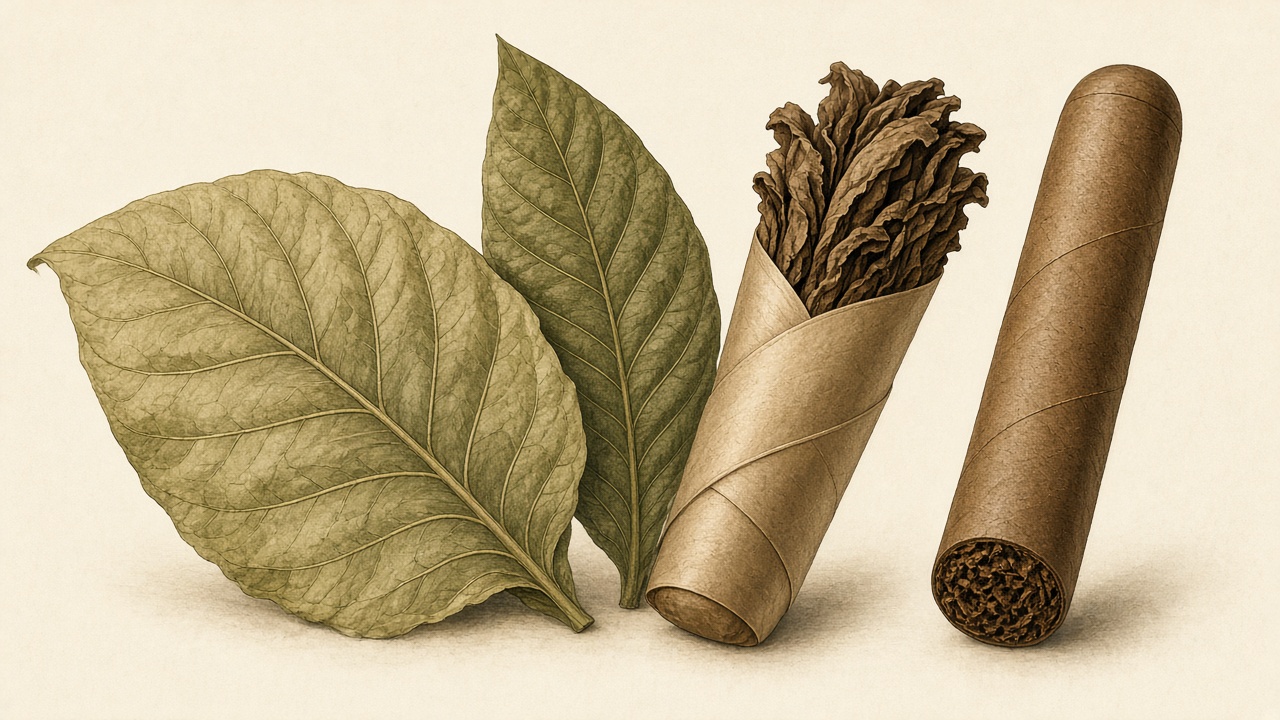
The plant
The leaf is not all the same. Where it grew on the plant decides the thickness, the burn, and the strength. Pickers take it in layers, from the bottom up.
The top leaves are ligero. They are thick and oily, and they burn slowly. They are the strongest leaves on the plant, so they go into the filler. The more ligero in that bunch, the stronger the cigar. The very top priming is sometimes called medio tiempo. Corona and centro gordo are the other leaves up high.
The middle leaves are seco. They carry more aroma and less strength than ligero. A binder is often a seco leaf: tough enough to hold the filler in shape, and not meant to be the taste. Centro fino, centro ligero, and uno y medio are middle primings.
The bottom leaves are volado. Libra de pie is the lowest of them. They are thinner, and they burn freely. A wrapper has to burn as well as look even, so a flawless leaf from down here can be used for the outside. Most leaves are not even enough. A hole or a heavy vein shows, and those leaves become binder or filler instead. Once the three layers are rolled, their names are on Parts of the cigar.
Long filler and short filler
Long filler is whole leaves, folded into the roll. It burns longer, and the taste has room to change as you smoke. Short filler is chopped leaf. It packs less evenly, burns hotter, and is the usual filler in a machine-made cigar.
After the harvest
The leaves are cured, then fermented in piles. Fermentation is what takes the harsh green taste out. The thick ligero from the top needs more moisture and more time in the pile than the thin volado from the bottom. The center vein is stripped out. Wrapper leaves are deveined with particular care, because a hole in the wrapper shows.
The stripped leaf is baled and aged. That rest is often a year, and it can be several, in a room held near cellar conditions. Most of the time in "how a cigar is made" is this waiting, not the hour it takes to roll one.
The roll
When the leaf is ready, a roller builds the filler, wraps it in the binder, and lays the wrapper on in a spiral. The head is finished with a cap, the small piece you cut later. A handmade cigar is rolled by a person. A machine-made cigar is the other path. The product says handmade when we know it.
Before it is boxed
Fresh cigars rest again, commonly in cedar, near 70°F and 70% humidity, before they are sorted by color and boxed. That rest is why a cigar that was rushed out of the rolling room tastes sharp. Where the cigar lives after you buy it is Humidor 101.