Parts of the cigar
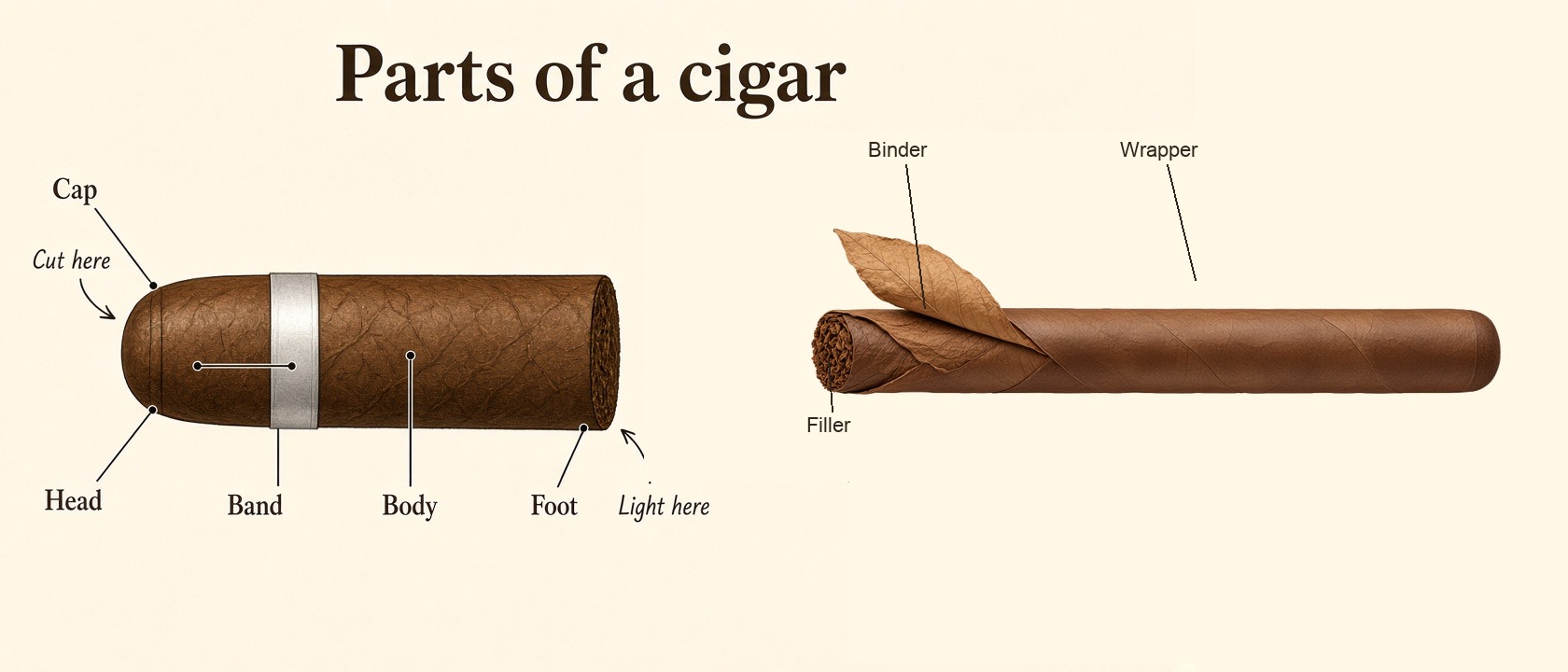
A handmade cigar is a blend of leaves, not one leaf rolled up. Three parts do the work: the filler in the middle, the binder around that, and the wrapper you see. The blend is the recipe. A maker changes the amounts when the size changes, so a robusto and a churchill of the "same" cigar are not always the identical mix. The names of the ends, and the cap you cut, are the rest of what you need before you light one.
Wrapper
The wrapper is the outer leaf, and it is the thinnest of the three. It can be quite light in color. It is chosen because it looks even and because it carries a large share of the aroma. Leaves with heavy veins, blotches, or holes are usually kept out of the wrapper and used somewhere else, or not at all. A lighter wrapper and a maduro are broad groups, not a single farm. The product page names the wrapper color when we have it. That word is also in the Cigar Glossary.
Binder
The binder is one leaf just under the wrapper. It is still only a leaf, darker than the wrapper and a little less thin, never a thick shell. You do not see it once the cigar is finished. Its job is to hold the filler so the cigar keeps its shape. Many cigars use one binder leaf. Some use two. A wrapper leaf that was sound but not pretty enough for the outside is often used here.
Filler
The filler is the bunch in the center. Long filler is whole leaves, folded into the roll. Short filler is pieces. The filler is where a blender mixes leaves from different fields and years. Leaves from higher on the plant are stronger. Leaves from lower down burn more easily and taste milder. The mix of those, more than the band, is the cigar. A tight filler draws hard. A loose one burns hot and fast. How that feels when you smoke it is on How to smoke.
Cap and shoulder
The cap is a small piece of wrapper that closes the head, the end that goes in your mouth. A line, the shoulder, shows where the cap ends and the body begins. Cut on the cap side of that line. Cut below it and the wrapper unravels. A rounded head, such as a robusto, has a gentle cap. A torpedo comes to a point, and you take off only the tip. Some cigars are finished with more than one cap layer. The cut is the same either way: open the cap, leave the shoulder. The tools are on Cutters 101.
Foot
The foot is the end you light. On a straight cigar, a parejo, it is open and flat. Toast that whole face so the burn starts as a ring, not a stripe down one side. A few tapered shapes, notably a perfecto, close the foot as well as the head. That closed foot needs a small opening, or a careful light, before it will catch. The shapes are on Shapes and sizes.
Band
The band is paper, not tobacco. It names the cigar. It does not have to come off to smoke it. A large band that will burn is worth sliding off once the cigar is warm. Bundles and factory seconds sometimes have no band, or a plainer one, because the regular band is part of what you are not paying for. Factory second is in the glossary.