How to smoke
A cigar has a closed end, the head, and an open end, the foot. You cut the head and light the foot.
If the cigar is in cellophane, a paper sleeve, or a cedar sleeve, take that off before you light it. A large band can come off too. Leave a normal band on if you prefer; it does not have to come off to smoke the cigar.
Cut the head with a cutter. Look for the cap, the small round piece of leaf that holds the head together. There is a line where the cap ends. Cut just above that line, not through the body of the cigar. One firm cut is cleaner than several timid ones. Put the cigar in your mouth and draw. If no air comes through, take a little more off the cap.
Light it with a butane lighter or a match. A fluid lighter (the kind made for cigarettes, with a gasoline smell) changes the taste. The rest of the light, and what to do when the burn runs to one side, is below. You do not inhale the smoke. When the cigar gets hot and harsh, set it in an ashtray and let it go out. Do not crush it the way you would a cigarette. That smell stays in the room.
What to have nearby
A cutter, a butane lighter or a match, and an ashtray with a wide rest. That is the whole kit. The short list is on Basic tools. How to choose each one is on Cutters 101, Lighters 101, and Ashtrays 101. Where the cigar lives between smokes is Humidor 101. The names of the parts are on Parts of the cigar.
Lighting, and an even burn
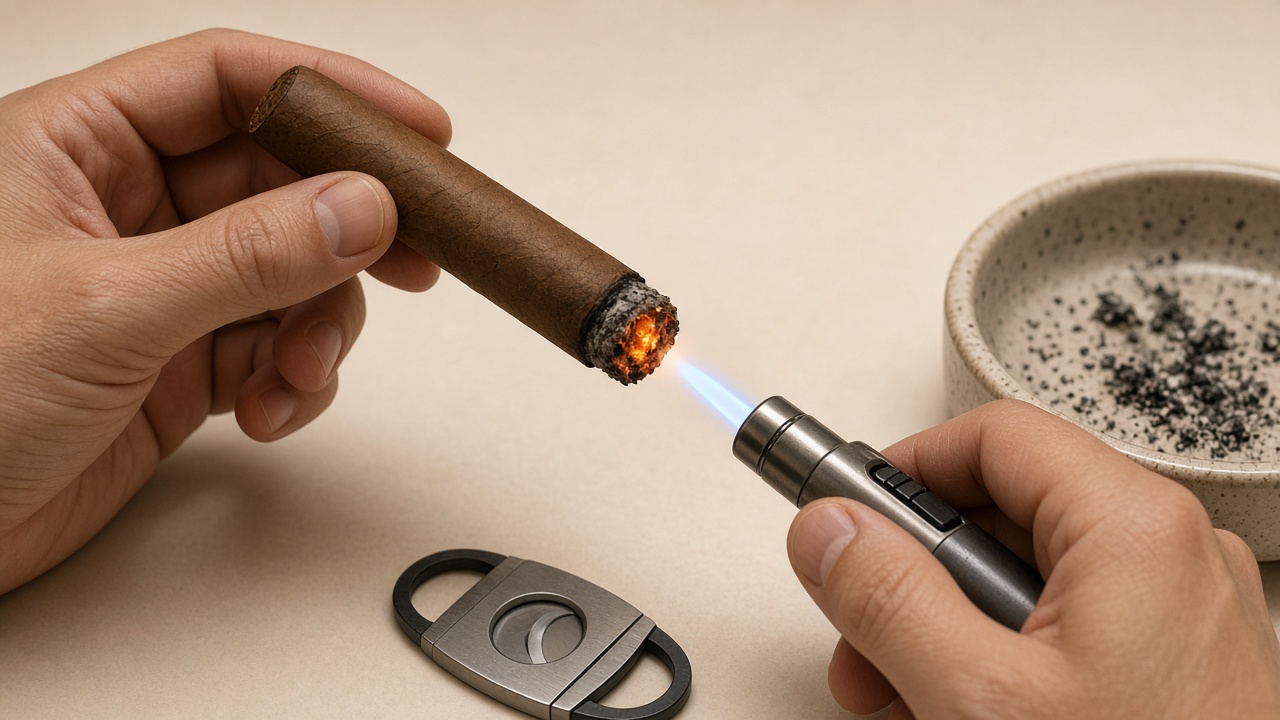
Toast the whole foot before you draw. Hold the flame just off the leaf and turn the cigar until the rim glows all the way around. Then draw gently and blow across the foot. You want an even orange ring, not a hole in one side.
A burn that runs ahead on one side is usually a rushed light, a draft, or puffing too hard. Hold the flame on the slow side for a moment. You can also knock the ash off and set the cigar so the slow side is up, and let it catch up. Touching the jet to the wrapper scorches a trench. If the cigar tunnels (a hole down the middle while the wrapper lags), it was often too damp, or the light never reached the rim. One careful relight can save it. Lighting it over and over will not.
How to draw
Take the smoke into your mouth, not your lungs. About one slow draw a minute keeps the burn even. Puffing hard heats the cigar and makes it bitter. Rest it in the ashtray between draws so the head is not in your hand the whole time. A long ash usually means the cigar was rolled well, but let it fall before it leans and cracks the burn.
How long it lasts
Time follows the size, and how often you draw. These are sitting times for a slow draw, not a promise:
- A cigarillo is often under 20 minutes.
- A petit corona is about 20 to 30 minutes.
- A corona is about 30 to 45 minutes.
- A robusto is about 45 minutes to a little over an hour.
- A toro is about an hour to an hour and a quarter.
- A churchill is about an hour and a quarter to an hour and a half.
- A double corona or a giant is often past an hour and a half.
Drawing twice as often shortens that and makes the smoke hot. There is no score for finishing it. When the smoke turns hot or sharp, usually in the last couple of inches, you are done. A cigar that goes out can be relit once if it has not sat for long: knock off the ash, blow through it gently to clear the dead smoke, and light the foot again. Relighting a cigar that has been out for hours tastes stale. Let that one go.
If something is wrong
A tight draw usually means the head was not opened enough, or the filler is packed hard. Cut a little more, or use a punch to open a small hole, then try again. A wrapper that cracks near the head often means the cigar was too dry. That one will not repair itself mid-smoke. The next one belongs in a humidor.